Tuesday, 8 May 2012

Mass Effect 3: Review

It's been quite a while since my last update, been rather preoccupied to say the least but I'm back at it finally, need to flex these fingers. Now I've been an avid gamer for the best part of seventeen years, nearly my whole life in fact, and there's no denying the impact gaming has had over the past decade. I was very fortunate enough to be an early product of the 90's where gaming was in my mind reaching it's peak and entering a new renaissance if you like, and becoming the now immensely popular and universal medium it is today. Video games have now transcended popular culture and our very way of life and have become an integral part of millions upon millions of peoples lives all over the world. It's remarkable really to have been there and seen it evolve from something a minority did as merely a casual hobby or interest whether it was going to the arcades with friends or playing on the early SNES or Sega Mega Drive, to now this deeply fervent and ubiquitous culture with an almost voracious legion (for lack of a better word) of enthusiasts who now literally 'live and breathe' video games. This transition has been the biggest eyeopener for me and how cultures radically change and the public consciousness to now appeal to this mass-market platform of interactive entertainment. The 90's were a pivotal moment for gaming and it's eventual expansion of that I have no doubt. The NES, Mega Drive, SNES, N64 and the PlayStation which I all owned undoubtedly paved the way for what is now the seventh generation of video game consoles with talk of an eighth generation of consoles just on the horizon as a tantalizing prospect for the future. I and I expect many other early gamers never would have predicted how far the gaming industry would actually come in such a short space of time and I only hope it continues to evolve.

Mass Effect 3 is the final installment in developer BioWare's epic, sci-fi trilogy in which you take the role as Commander Shepard once again in a galaxy crumbling and on the brink of total destruction and annihilation against an unstoppable enemy.
Anyways, now to the meat of the issue before I start to go off on a major and I mean MAJOR tangent and bore you with my anecdotes of growing up playing games (that would take up a further ten paragraphs let me tell you). Now, I'll admit as a self-professed 'avid gamer' bordering on obsessive even, I became distracted and veered dramatically away from games and consoles altogether in mid 2011 to early 2012. I started to completely lose interest, and to quote a friend on Xbox LIVE who said: 'Dan, according to your gamer tag it's been like 395 days since you were last online!" and it immediately struck me. Was this just a phase? And then the frightening notion crossed my mind, had I grown completely out of gaming for good? Possibly, after all there is more to life than playing video games but you could NOT tell me that say six or seven years ago, even ten years ago. I had played video games almost religiously back then and it became something of an unhealthy addiction at one point particularly with World of Warcraft...I'll say no more (it's a wonder I didn't get a deep vein thrombosis with the amount of hours I sat on that bloody chair). I then decided to make a conscious effort to try and get myself back into my old hobby by getting a new game which I hadn't done in nearly two years. This new game was Mass Effect 3, a game I was originally going to get on launch day but didn't bother afterwards. I was a huge fan of the first two games and had clocked up in excess of approximately 300 hours playing time combined which is A LOT really. Developer BioWare had expertly and meticulously crafted an inescapable, engrossing and beautifully complex universe in all of its intricacies with a rich and colorful cast of unforgettable characters with the major theme of choice and consequence at the very forefront of each and every installment. 

The first two games were outstanding in there own right, and the sheer attention to every conceivable little detail no matter how minor or insignificant was incredibly impressive. The first Mass Effect released back in 2007 introduced us into the role of Commander Shepard whose face was fully customizable and had immense fun toying around with that let me tell you. Set in an epic, politically charged and fully realized universe which would give even the likes of Lucas a run for his money, Mass Effect was clearly a very ambitious title an definitely a staple of what we have come to expect from BioWare. It had it's flaws for sure namely with the problematic AI  and combat, some minor technical glitches, graphical hiccups and some repetitive side missions but the overall experience was excellent particularly it's deeply engaging story, characters and setting and it provided a very solid groundwork for where the series could go. The core strength of the game was in it's interactive storytelling, using life-like facial animations and expressions to convey this deeper emotional bond with the characters which was unlike anything I had seen in a game before it. It certainly set the bar high, pushing the envelope along with it and fans such as myself were clamoring for the next installment to come along. Mass Effect 2 was the answer, and the developer boldly went with a more streamlined action-RPG experience compared with the first game which was heavily laced with RPG elements such as customizable weapons and armor and a flexible leveling up system etc. This came as quite a shock to me at first but I quickly realized how vastly superior it was to the first game on almost every level. By stripping away certain elements, they focused primarily on delivering a more action-oriented experience and as result provided a more refined experience overall, particularly with the combat. 
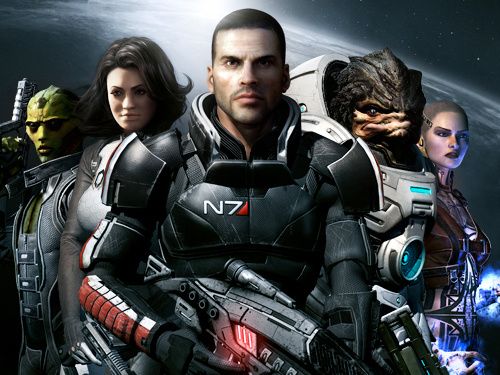
Some of the cast of Mass Effect 2, which was something of a departure from the first game in favor of a more streamlined and action experience, a bold and ultimately successful move by BioWare in my opinion.

Anticipation for the final installment was almost palpable, and the fan base had grown exponentially since the first game. Expectations were sky-high, and devotees around the world were all itching for the final chapter in what would be the epic conclusion of the trilogy. I know I had to replay the first two again to get myself back in-sync with the story and remind me how deeply fond I was of the series in general, particularly the characters. Some of these characters had been at your side from the very first game, and it was hard not to have this deeper and profound bond with them. Garrus: the straight-talking, no-nonsense, hard-nosed Turian who you instantly had an affinity for that would later evolve into this camaraderie and brotherhood almost that was completely unique. He was a brother-in-arms from the get-go not to mention having a heap of quotable lines, and he is by far my favorite character of the series without question. Then there was Ashley: a gutsy, feisty Alliance solider with a bigger set of balls (or quads as Wrex would call them) than most men who was instantly likable and of course dare-I-say sexy. Of course how could I forget Wrex: 100% unadulterated Krogan badass-ness enough said really, who also has a list as long as my arm of kick-ass dialogue. There was of course Kaidan, Liara and Tali who also had there own distinctive characteristics and personality traits to set them apart to make for an amazing ensemble who you cared about. With the stakes as high as they've ever been in ME3, I wanted to see what would happen to my squad mates and how this conflict would shape and effect them. No one does a character-driven narrative quite like BioWare does and I had enormous faith in them to deliver on all promises.  

So Mass Effect 3 picks up pretty much where the Arrival DLC from Mass Effect 2 left off with the grim and inevitable arrival of the Reapers, an ancient race of machines who have come to purge the galaxy of all organic life in an endless cycle of destruction that occurs every 50,000 years. Earth's fleets and defenses are all mobilizing to protect the planet from the incoming Reaper threat who are quickly descending on the Milky Way despite Shepard's vain attempt to keep them at bay by destroying the relay in Arrival. Back on Earth, Shepard has been dismissed from the Alliance and arrested pending a trial in which he caused the destruction of the Bahak System killing 300,000 Batarian colonists (Arrival). A few months later, he is met by Anderson who is now an admiral with alarming news that the Reapers are quickly advancing on the Sol System with nearby colonies mysteriously going silent. Depending on your whether you choose to keep Ashley or Kaidan alive in Mass Effect back on Virmire, they will meet you briefly (I must say I love Ashley's new look ooof!) before you have to go before the committee with Anderson about the Reapers. They then get an incoming feed from the UK in which London is being completely devastated by the Reapers. Shepard matter-of-factly declares this isn't about strategy or tactics but about survival. Then an ominous sound is heard coming from the skies above, the councilors turn back at the window in disbelief before a Reaper descends and completely vaporises them with a laser beam. The huge impacts throws Shepard into a wall, and as Timon the meerkat from The Lion King would say "It starts...".   

London's Burning. The Reapers doing what they do best: complete and total annihilation of everything in there path, though Big Ben is spared of the new Reaper makeover...for now.

Now right off the bat you'll notice that the graphics are pretty similar to the second game, though I did notice overall better visual fidelity in particular with the stunning set-piece battles you'll witness. The awe-inspiring backdrops of the Reapers wreaking havoc on the surroundings is jaw-dropping and really does set the tone for this dark and final chapter. Wherever you go, particularly with the Priority missions the gargantuan Reapers are always a constant presence and it really does convey this feeling of a desperate stand against seemingly overwhelming odds. The developer has really done a fantastic job of portraying this mass destruction on a utterly colossal scale, and it really does draw you in from the get-go. Combat is largely the same as in ME2 with some minor refinements including improved enemy AI who now take cover more effectively and employ tactics to flank around you in larger open spaces. It's no surprise BioWare did little to change the overall combat experience since it was already really good in ME2. AI squad-mates surprisingly hold there own in the heat of battle now rather than become an annoyance like in the first game, which will save many controllers being thrown at usually expensive TVs and you having to fight a whole wave singlehandedly which is never fun. The weapons themselves can be fitted out with mods that can be retrieved or purchased to improve accuracy, damage or ammo capacity which prove invaluable in the latter battles. It offers some customization with the armors but it's still limited in comparison with the first game, again emphasizing on a more streamlined experience which works again here. 

Mass Effect 3's main strength and has been since the first game is in it's storytelling as well as it's characters. Depending on whether they survived the Suicide Mission in ME2, all the familiar faces who we've grown to know and love over the course of the series will be making a return here. They literally get thrown at you left right and center almost, it kind of felt really forced and deliberate at first but these characters after all are your emotional tie to the unfolding story and its great seeing some old faces who are all involved in this conflict as much as you are. The likes of Ashley or Kaidan, Garrus, Mordin, Grunt, Wrex, Tali, Liara, Jack, Miranda, Legion, Thane, Samara and Jacob all play into the story with some even rejoining your ship either permanently or briefly. Once again the voice acting is absolutely topnotch across the board, BioWare has to be applauded for finding arguably the finest cast ever to grace a video game series. Throughout the course of the 20-30 hour experience you will be standing by old friends as they try to fend off the Reaper threat which hits a little closer to home both with them and with you. I will say it's probably the most emotionally charged of the three games which in essence it should be, and I will say no more than that with risk of spoiling it all. I can't say I ever recall a game in which I felt so emotionally invested in than Mass Effect 3, after all these are the characters who you have grown to love for nearly five years now and it will undoubtedly tug at your heart strings like it did with me. The game itself as a whole package is probably the best of the trilogy, certainly leading up to the ending anyways which...well I'm sure you've heard has caused something of a storm among the gaming community and for good reason. 

     
Now the ending has been the subject of much speculation not to mention widespread indignation from fans who felt it lacked closure as well as betraying some of the core themes of the series. My personal opinion of the ending was that it was very disappointing, in fact I'm not going to address it in this review but rather a separate and in-depth article later on. However, that being said I don't think the ending should take away from what a truly incredible game this is overall. Mass Effect 3 is a 'fitting' conclusion to one of the most beloved and intricately crafted video game franchises of all time. The ending in it's current state is a massive disservice to fans if it turns out to be the real ending, but it would be unfair to slam the entire game based only on the ending cause the rest of the game is SO good. It provides a great continuity for those who have played the first two games, and I would recommend playing them first if you haven't already before you jump into this one.

4.5/5
The Good: Incredible visuals and sound design, an engrossing and emotionally involved journey to the conclusion, awesome combat and improved enemy and squad AI, top-draw voice acting and writing really bring the characters who have now reached 'legendary' status to life, multiplayer is surprisingly enjoyable and also somewhat integral to the main game.
The Bad: Disappointing and inconsistent climax that lacks closure and betrays the staples of the series. Some frame-rate dips here and there.
The Ugly: Did I mention the ending? 
         

Monday, 9 April 2012

Derren Brown: Svengali Review


Now, before I begin I want to stress right off the bat that this review will contain minimal spoilers, as I have been sworn to secrecy by the man himself not to give anything away, and no this wasn't some deliberate act of suggestion and I'm not under the influence of any psychological trickery, just so were very clear on that. For those of who have lived in caves for nearly ten years and don't even know who he is, Derren Brown is a 'magician' of sorts, though that is a term I and he would use very loosely. As opposed to most of the garden-variety magicians who rely solely on using the established, tried-and-tested tricks of the trade, Derren's work encompasses a broader spectrum. He fuses degrees of psychology, suggestion, misdirection and obviously a helping of showmanship to achieve his results. A majority of Derren's tricks have more of a psychological bent, and he can seemingly pick up on and interpret the unconscious signals that we give off, as well as subtly manipulate your mind to the extent that he can directly influence your thoughts and very behavior through suggestion and other techniques. It's no wonder he seems to leave his audiences completely dumbfounded and stupefied on every occasion, me now being among them and it's no exaggeration to me to label the man a genius on every level and in every respect. A true master of his craft and to me one of the finest contemporary performers in years.

I first came across Derren's work way back in 2003 with his Channel 4 series Trick of the Mind, though I was too young to really grasp it completely, I was nonetheless intrigued. I had always taken a keen interest in magic from as early as '98 where I used to watch Breaking the Magician's Code: Magic's Biggest Secrets Finally Revealed almost religiously on a weekly basis. That was what really started it all for me as a kid, and I eventually went out and bought Magician Kits (sad I know...), and had a gallimaufry of other magic-related accessories and gimcracks and was something of an amateur junior magician in my time, to my two cousins at least anyway, though they were easily impressed and I wasn't about to make a career of it anytime soon as much as I really wanted to. It wasn't until much later in 2007 with his new series Trick or Treat that I was truly under his spell, a spell that still hasn't broke to this day. Spellbound I was to say the least, and from then onwards I was a devotee of Derren, and his already large fan-base only grew every time a new series or television special would come along. The one special which would permanently seal his status forever and subsequent notoriety was undoubtedly Russian Roulette in which he had to accurately predict which chamber the participant had put the bullet in while he fired off all the other remaining chambers with the gun pointed at his head. 

Derren's Channel 4 series Trick or Treat which was first broadcast way back in April 2007, was what started me off and from then on I was completely hooked, I had been 'converted'.

Russian Roulette really did push the envelope and made him a household name. It attracted much controversy at the time, but I think people failed to see it for what it was: pure, unadulterated entertainment that made for some truly fantastic television. I didn't see the original broadcast but when I saw a repeat of it (I forget when) I was amazed, and the climactic few moments was so intense it was literally nail-biting. I know I didn't need to cut my nails for a while after that, my teeth had completely grounded nearly all of them to there bases. Derren's execution (not literally thank god) was sublime and the whole production itself was first-class, had never seen anything like it on TV. Many offered explanations as to how it could have been done, perhaps through NLP (Neuro-linguistic programming) which is kind of a pseudo-science based on cognitive and behavioral psychotherapy. Derren after all is a 'mentalist' by definition and relies heavily on psychological manipulation to help disguise his tricks, so its probable that through this technique and the power of suggestion he was able to persuade the contestant to put it into a certain chamber. People have also raised doubts over whether the gun was in fact loaded with a live round due to strict regulations, particularly of a big company like Channel 4 who wouldn't let anyone under any circumstances be harmed. Whatever the reasons or explanations people come up with it's irrelevant really, it was just amazing to watch and he is first and foremost an entertainer.  

After that I went out and purchased his book Tricks of the Mind which is a great read and would recommend it to just about anyone who has ever taken even a casual interest in what he does. I then subsequently bought all his DVD's including the television specials which included the infamous Russian Roulette and three others Séance, The Heist and The System as well as his stage shows: Something Wicked This Way Comes, An Evening of Wonders and Enigma. It would be fair to say I was quite obsessed, but watching Russian Roulette and Trick or Treat only offered a glimpse, a taste if you like of Derren's true brilliance. Séance was absolutely phenomenal, one of his best for sure and even my father who might I add is notoriously hard to impress was quite surprised at how good it actually was. It really did showcase how far he was willing to push boundaries and branch out in directions that I wouldn't have ever seen coming. The Heist raised the bar even further and the sheer scope and ambition of it was awe-inspiring, another jaw-dropping feast from start to finish. Derren never fails to deliver and astound for me and it was only after I watched his stage shows that I knew I just HAD to see this man live and in 2011 that unique opportunity finally came along.

When Russian Roulette was broadcast in 2003 it completely shocked the nation and was one of the most complained about shows in television history, not Derren's intention I'm sure...yeah right.

I actually stumbled upon his new tour Svengali almost by accident, I wasn't even aware he had a tour until late 2011 when I read that someone had been to see him in England somewhere, Manchester I think it was. It was then announced that he would be coming to Cardiff in April for the 2012 leg of the tour and I immediately snapped up the tickets for me and a work mate who was into Derren about as much as I was. I could hardly contain myself when the tickets finally came through the post, April 9th could not come quick enough. Fortunately it did come around quick and before I knew it I was waiting for my friend outside the Millennium Centre. We were both all giddy like a pair of primary school kids, the sheer excitement and anticipation was almost palpable and there was an immediate buzz in the theatre as we took our seats. The place was completely packed out which was no surprise really, about 1,600 of us in all, we couldn't spot a single empty seat. Now we both went in with pretty high expectations already cause we knew all to well what this guy was capable of, we were what you call the 'hardcore' fans if you like. However, actually being there was something else, we more or less had a perfect almost panoramic view of the stage since we were sat in the Upper Circle. 

A view of the Svengali stage from the Dress Circle, not quite sure where this is but it gives you an idea at least, will say no more...

Now as I've stated before I will not be spilling any beans on the show itself, Derren specifically asked us all not to at the beginning and I will stand by that. What I CAN say though is that it completely blew all my expectations, which were already high might I add. Me and my friend were utterly engrossed from start to finish, without a shadow of a doubt his finest stage show to date and for me one of best two and half hours of my life. I was so relieved he didn't pull that trick like in The Gathering by hypnotizing the audience into making them forget the night's events cause that was a show that I would not want to forget cause it was so unforgettable. A mind-boggling, jaw-dropping, rip-roaring thrill ride in every sense. Derren completely outdone himself and to actually see him in the flesh for the first time was amazing in-itself, a dream come true for sure. He is a master showman who oozes charisma and has such an incredible energy and wit on stage that is as sharp as his suits (nice one it was to), or the better comparison would be as sharp as his tricks that left the whole theatre gasping in awe on no less than...can't even remember how many occasions now but it was a lot. I know I shook my head in utter disbelief and amazement numerous times and so did my friend. If you EVER get even the slightest fleeting chance to see his Svengali tour then I wholeheartedly suggest you go see it, it will be one you'll never forget I assure you.

Derren's ultimate goal in my mind has always been to challenge his audiences, and he is constantly testing the waters, offering fresh and new perspectives on what he does. He is not about deceiving people into believing he has some kind of special powers or sixth sense, he is inviting you to make up your own mind and come up with your own interpretations. I mean sure his performances involve some degree of deception in misleading the audience, but he uses this to great effect and we must not forget that he is a showman. In his career he has effectively debunked many paranormal practices that have become well established, particularly mind-reading and mediumship which is still a huge business today. He has pealed away the superficial layers of it all and exposed it for what it is. If you have watched Séance then you'll know what I'm talking about cause that was a real eyeopener for me and I imagine many other people as well. You believe whatever you want to believe but its crystal clear to me now that psychics, mediums, palm-readers and the like are ultimately duping often quite vulnerable people into believing in something that's false. They are in a sense preying on there vulnerability, especially mediums, and giving them a false sense of hope which to me is wrong. It maybe gives them a sense of solace and comfort to know that there loved ones who have passed are still somehow here, but they are being led on.    
 
Anyways, I've watched Something Wicked This Way Comes, An Evening of Wonders and Enigma countless times but Svengali is not only his best but his darkest and most ambitious to date. Yes, there will be some familiar aspects of the show that you would come to expect from Derren, his use of suggestion and other linguistic tricks that have become part of his established repertoire, but even then he still manages to make even that feel fresh and original. It never fails to amaze me how he can accurately interpret every conceivable detail no matter how subtle, he is always bang on the money more or less every time and that is an incredible feat for someone who believes that he himself doesn't possess any 'psychic' ability and even denounces those who claim they do. He is a prominent skeptic and even though his performances incorporate mind-reading and other feats of mentalism that appear on the surface a result of some psychic or paranormal practice, he believes that his tricks fundamentally are grounded in reason and psychology. Derren has never claimed he has any psychic ability and unlike some performers who masquerade as psychics, mediums or having some kind of extrasensory perception, he doesn't. To the point though, Svengali is absolutely sensational, his crowning achievement by far and rather than me constantly waffle in superlatives here (I could go on all day...) you genuinely MUST see it for yourself!

Sunday, 8 April 2012

Akhenaten: A 'Heretic' To His People, A Revolutionary Pioneer To All.

Akhenaten the 'Heretic' King, though born Amenhotep IV, he would later change his birth name which meant "the living spirit of Aten".


I have always been fascinated by Ancient Egyptian mythology and culture since a very early age. The sheer richness of it's mythology and the ingenious majesty of it's grand architecture, particularly The Great Pyramids at Giza was what piqued my interest in the beginning. However, it wasn't long before I became completely engrossed in it all and it inevitably led me to delve in deeper. It almost became an obsession of sorts, and I wanted to know everything, every conceivable little detail no matter how insignificant or mundane, there was no stone left unturned. In my relentless quest for knowledge, I stumbled upon Egypt's 'heretic' king Akhenaten, a man who abandoned the traditional polytheistic (belief in many gods) beliefs that the Egyptians had held for centuries in favor of only one god, the 'Aten' or sun disk. It struck me that he was in fact the very first who made this incredibly bold and radical shift from established and incontestable tradition, and yet we still know very little of him or what truly motivated him to forsake conventional polytheism in favor of unorthodox monotheismNow, I don't need to point out the obvious similarities here, but I will get round to that later.

What we do know about him is that he was a pharaoh of the Eighteenth Dynasty and was the son of Amenhotep III, also known as Amenhotep the Magnificent. His reign of 39 years was a period of exceptional prosperity and artistic splendor at a time when Egypt reached the height of its power. He would be known as the pharaoh who 'beautified' Egypt. Amenhotep III put an emphasis on construction as opposed to conquering other lands like his predecessors, since times were abundant and there was no real danger or threat. He expanded on many existing cities and constructed many temples during his reign including Malkata on the West Bank of the Nile at Thebes, the then capital of the unified Egypt and it was a site dedicated to housing and official chambers. However, his greatest and most noted achievement was the Temple of Amun at Karnak, better known today as the Precinct of Amun-Re which is the largest of the precincts at the temple, and still remains a popular tourist attraction. Amenhotep III died approximately between 1353 or 1351 BC after a reign of nearly 40 years, and his son Amenhotep IV immediately succeeded him and was crowned in Thebes.

The ruins of Amarna or Akhetaten which meant "Horizon of the Aten."

During the early days of his reign, Amenhotep IV was based in Thebes with his wife Nefertiti and his six daughters. In the beginning he permitted the worship of Egypt's traditional gods, however at the Temple of Karnak he decreed several massive buildings including temples to the Aten. The Aten itself was depicted as a sun disc, and was previously unheard of in traditional Egyptian architecture. The relationship between him and the priests of Amun-Re or the established order started to gradually decline and during about year five of his reign, Amenhotep IV took decisive action and eventually took it upon himself to establish the Aten as the sole, monotheistic god of all Egypt as opposed to his early henotheism (belief in one god while still accepting the existence of others). He "disbanded the priesthoods of all the other gods and diverted income from these other cults to support the Aten". To declare his complete allegiance to the Aten, the pharaoh then officially changed his name from Amenhotep IV to Akhenaten which meant the "Living Spirit of Aten." Akhenaten then soon commissioned the building of Akhetaten (known today as Amarna) which would serve as the new centralized hub for all religious practices in Egypt. 


The pharaoh Arkhenaten giving an offering to the Aten. Notice his rather 'feminine' characteristics which was present in almost all known inscriptions of him.

This radical change must have come as quite a shock to the populace, and no doubt it incited much hostility and widespread indignation across Egypt. The idea that the gods they once revered were now suddenly declared obsolete in favor of just one, this must have been nothing short of heresy. Arkhenaten even went to the extremes of personally ordering the defacing of Amun's temples throughout Egypt, and in many instances he had the inscriptions of the other gods removed all together. To those who aren't as familiar with Egyptian mythology Amun was a patron deity so called 'King of the Gods' and was undoubtedly the most venerable of all the Egyptian gods, particularly in the New Kingdom where he was "greatest expression of transcendental deity In Egyptian theology". Initially, Akhenaten presented Aten as merely a variant of the familiar supreme deity Amun-Re (itself the result of an earlier rise to prominence of the cult of Amun, resulting in Amun becoming merged with the sun god Ra), in an attempt to put his ideas in a familiar Egyptian religious context. However by year nine of his reign, his sheer devotion and allegiance to the Aten became so resolute and immovable he finally declared that Aten was not just the supreme god but the only god, and that he was the sole mediator between the Aten and his people. 

It's no surprise that his death, which is also shrouded in much mystery and speculation, marked the gradual decline of the Aten cult he had originally founded and it was quickly repudiated and fell out of complete favor. His conviction in his monotheistic beliefs and the very concept of a sole god was just too radical for his people to accept or follow and it wasn't long before the order of the old gods was finally restored after his 17 year reign. His later successors, particularly Ay and Horemheb worked tirelessly to remove all trace of the 'heretic' king and his 'legacy' by disassembling temples and monuments that Akhenaten had built, including the one at Thebes. The city of Akhetaten was abandoned and left to ruin by his own son and eventual 'boy king' Tutankhamun, though he was originally born Tutankhaten which meant "Living Image of Aten," he would later change it to Tutankhamun "Living Image of Amun." Later pharaohs would not even acknowledge he existed at all and any depiction of him or the Aten was completely destroyed or its material reused for other monuments, it's like they wanted to erase him completely from history. 

To his people he was branded a 'heretic', but if you look at it in the wider scope of things it's clear that he was undoubtedly the precursor to monotheism. The foundation of three of the world's largest faiths: Judaism, Christianity and Islam are based on the concept of a single god, a concept that began with Arkhenaten himself almost two centuries prior to the first archaeological and written evidence for Judaism and Israelite culture was even discovered in the Levant. Many have speculated the idea that Akhenaten was the pioneer of a monotheistic religion that later became Judaism. Sigmund Freud himself mentioned in his book Moses and Monotheism, that Moses himself had been an Atenist priest who was forced to flee Egypt with his followers shortly after Arkhenaten's death. Freud argued that Arkhenaten was endeavoring to advance his monotheism further, something that Moses from the Bible was able to achieve. This was an utterly fascinating notion to me and even though I'm not the first to bring up the subject, yet if it managed to mystify and fascinate not only scholars but arguably one of the finest minds of the 20th Century then this was definitely something worth looking into further. I was immediately struck by how much of a debate it was and still is to this day, and there's no denying Arkhenaten's legacy which his people tried so desperately to expunge completely.


Judaism, Christianity and Islam, three of worlds largest faiths are all monotheistic religions, a concept originally established by Akhenaten almost two hundred years prior.

There is no denying Akhenaten's influence on later religions, in fact pottery that was discovered throughout Judea dated almost to the end of the 8th century BC has seals almost resembling a winged 'sun disk' engraved on it's handles. Is this merely a coincidence? Maybe, but I don't think so. Other scholars have even juxtaposed aspects of Arkhenaten's relationship with the Aten to the relationship Jesus Christ had with God - particularly in interpretations that emphasize a more monotheistic explication of Atenism than henotheistic. The Canadian Egyptologist and archaeologist Donald B. Redford added that many have viewed Arkhenaten as a harbinger of Jesus himself. This is certainly feasible since a majority of Jesus's life was completely fictionalized and romanticized in The Bible anyway and that the earliest scribes may have been influenced directly or indirectly by what this Egyptian pharaoh had been expounding to the extent that they plagiarized some elements. Did they essentially pick and choose what to add, what to discard and what to simply build upon? Possible, no one can really know for sure after all most great works of art or fiction take inspiration from earlier sources and Arkhenaten and his relationship with the Aten may have been the muse. Akhenaten even described himself as "thy son who came forth from thy limbs", "thy child", "the eternal son that came forth from the Sun-Disc", and "thine only son that came forth from thy body". Notice the distinct similarity here?

Redford concluded that: "Before much of the archaeological evidence from Thebes and from Tell el-Amarna became available, wishful thinking sometimes turned Akhenaten into a humane teacher of the true God, a mentor of Moses, a Christlike figure, a philosopher before his time. But these imaginary creatures are now fading away one by one as the historical reality gradually emerges. There is little or no evidence to support the notion that Akhenaten was a progenitor of the full-blown monotheism that we find in the Bible. The monotheism of the Hebrew Bible and the New Testament had its own separate development—one that began more than half a millennium after the pharaoh's death." That maybe so but it's still a tantalizing prospect that Arkhenaten's legacy may have played a direct role in shaping later monotheistic religions. He has been called by the historian James Henry Breasted and rightfully so "the first individual in history," undoubtedly the first monotheist, by definition you could even say the first scientist and romantic. A man who was steadfast in his convictions, irregardless of what his people thought. He defied convention and tradition and brought about a radicalism that Egypt had never seen and consequently would never ever see again. A true revolutionary who was way ahead of his time.

The English Egyptogolist Flinders Petrie declared that:
If this were a new religion, invented to satisfy our modern scientific conceptions, we could not find a flaw in the correctness of this view of the energy of the solar system. How much Akhenaten understood, we cannot say, but he certainly bounded forward in his views and symbolism to a position which we cannot logically improve upon at the present day. Not a rag of superstition or of falsity can be found clinging to this new worship evolved out of the old Aten of Heliopolis, the sole Lord of the universe.


Saturday, 31 March 2012

Why I'm An Atheist (A Highway to Hell Paved With Reason, Logic & A Spirit of Open Mindedness)


I like most others became involuntarily exposed to religious beliefs from my earliest childhood, I was young and impressionable like most kids, at a time when we are most vulnerable and susceptible to input of any shape or form. My Nan who I looked up to immensely was a devout Christian only because she had been brought up that way, she had become predisposed to those beliefs because it had been passed down from generation to generation. Her father and my great-great grandfather Isaiah Davies was a lay preacher who obviously had strong convictions that could not be contested because he to had been brought up that way. His faith was steadfast and resolute because his upbringing was stringent and his parents had obviously imprinted there faith firmly on him because that is how it had been done for generations, now he had become involuntarily 'conditioned' to believe and not to question. This was a startling and rather unnerving revelation to me and would shape my later beliefs. Imposing your own belief system on anyone especially a child is profoundly immoral in my view and not only obstructs there free will but also hinders future cognitive growth, or as Richard Dawkins quite rightly put it in The God Delusion 'intellectual high treason'.

Luckily, in my case it wasn't forced on me as such, certainly not drummed into my head anyway. My nan and I would often recite a little prayer before lunch or she'd read me a few passages of the Bible before we went to sleep. I was about maybe 6 or 7 years old at the time and this occurred almost every time I stayed over, it became almost routine and I simply went along with it. She played a pivotal role in my early childhood and was a central figure, a role model almost up until I was 9 years old when she tragically died. I adored my nan deeply, she was my inspiration, we were inseparable and I worshiped the ground she walked on (pardon the slightly religious connotation). I was far too young to really understand the gravity of what was going on when she passed, but I took some comfort in the fact that she was going to a special place or 'Heaven', a place we had talked a lot about. I was curious and incredibly inquisitive like most kids that age and she would tell me everything. 'Heaven' was meant to be a place you went to when you died, a lush paradise that I would often try and depict in my drawings since I was quite the artist when I was younger.


After she had passed, there was a deep void in my life which could never be filled, and throughout my early teens I considered myself a Christian, it was like I was picking up the mantle if you like after my nan. I felt I had a responsibility, and my years in primary school also had a dramatic impact on me and how it molded me into adopting this belief system. Every day without fail we would all be gathered in the hall and sing hymn after hymn, I recall vividly us singing All Things Bright And Beautiful, Creation Song, Oh Lord I Thank You and He's Got the Whole World in His Hands on an almost weekly basis. Our headteacher was a very religious man, and even though I'm sure it wasn't there intention to force it on us almost it still had an impact on me. I had become fully exposed throughout my adolescence and I was indoctrinated almost like many millions of people still today. This belief system had been manifesting itself for years and years, gradually building to a point where it was almost without question. However, fortunately in my mid teens I DID begin to question, I had matured and instead of reverting back and accepting without question all of this outpouring of religious-laden input, I became very open-minded.

A famous quote by Carl Sagan in which he clearly highlights the rather unsightly and unbelievably constricted perspective 0f many followers of religions.

I was now 15 and secondary school education had opened my eyes and mind to science, and immediately I was given a fresh and new perspective on things. My father who actually went to the extremes of actually 'de-baptizing' himself also opened my eyes to the wonders of science and astronomy. He was shall we say quite expressive about his atheism almost vehemently, and would often chastise those of faith in the flat, particularly militant faith and berate them particularly if a certain topic cropped up or any news headline regarding the ongoing heinous actions of religious extremists in the Middle East today. So, being in my mid-teens I was often far too preoccupied with other things to really consider myself a serious or particularly passionate Christian. I certainly didn't propagate it, attend church every Sunday, read passages from The Bible etc. I merely labelled myself 'Christian' and didn't really ponder the ultimate question of how exactly the universe came to be. Did I believe that the universe was created by some almighty, omniscient supreme being? Maybe, after all I couldn't really disprove it. I guess you could have called me an agnostic in that sense, a 'Christian' on paper but it was very much written in pencil and could be erased and changed at any given time, again it was this spirit of open-mindedness that presented me with choices that my nan and great-great grandparents never had, a choice. Life after all is about choices, and having the liberty of making them.

My new-found agnosticism had stemmed from the fact that just because a large group of people, primarily authority figures from my early life (teachers, my youth club instructor etc.) wholeheartedly believed in a God or a higher power didn't necessarily make it true. My mind was open and receptive to new ideas, and gazing up at the magnificent night sky in all of its splendor and grandeur only reinforced my desire to explore every possibility. I hungered for the answers and science seemed to provide the perfect dish to sate my insatiable appetite for those answers. However, as broad and complex as science now is it still doesn't hold all the answers and that was what was so alluring to me from the get-go. Science is constantly evolving, always straying in a myriad of different and exciting ways, always branching out and never ever set in one place or stuck to the same path. Metaphorically, to me science is that never-ending road, that infinite stretch of road with no set destination or course, just a inescapable vastness that is both daunting and dazzling. Always moving forward, never back, it is that forward and progressive momentum that science has over backwards and stagnant religion, that is it's trump card and it's also it's greatest challenge. 

This so-called 'Wheel of Power' taken from a Christian website perfectly encapsulates this very fractured and circular belief system, in complete denial, an almost pertinacious adherence to something based on no factual evidence.

The central ideological foundation of science has always been to question, religion however is unquestionable and this startling realization had planted the seed that would eventually lead me to dismiss religion completely. I found it almost incomprehensible why those of a staunch religious belief system refuse to even take this bold and radical approach with a pinch of salt. They have regrettably become indoctrinated and there are many, primarily extremists who make a lifelong commitment in expounding there nonsensical and often pernicious dogma on vulnerable individuals. This act of dictating another human being's beliefs, and dressing it up in an ugly, often heinously narrow-minded and ignorant view of the world with this warped, pseudo-moralistic stance that encouraging violence in the name of there god or religion is completely 'justified'. It is truly the ultimate form of bigotry or intellectual high treason on a grand scale, not to mention being completely unethical on every level. I am of course referring only to the minority of extremists who continue to infect the world with there poisonous ideals, promoting and endorsing violence on innocent people all over the planet. What compelled those nineteen 9/11 hijackers to fly those planes into those buildings killing nearly 3,000 people? Simple, religion. Not the peace-loving and innocent sort that embrace tolerance, equality and a greater moral standing but a warped and truly malignant hybrid that needs to be vanquished and quick. 

Thousands of years ago during the rise of the first great pre-modern civilizations such as the Mayans or the ancient Egyptians, they used the rich mythology that they had fabricated to give meaning to what was going on around them. The ancient Egyptians believed that the sun was the manifestation of the sun god Ra who had become a major deity in ancient Egyptian religion by the Fifth Dynasty and one of the most revered. They believed that Ra traversed the vast skies on a solar boat accompanied by other the gods. Sun worship was particularly prevalent in ancient Egyptian religion, but they naturally had a very limited understanding of the wider scope of things. Religion back then served as both a primitive form of control and a purely fantastical and exaggerated conception of the world around them and beyond. This was completely understandable back then, but now in our modern society surely we would have all rejected those narrow, fantasized and primitive fabrications of our incredible planet and the seemingly infinite universe that we are in. Well, unfortunately that hasn't happened and the dominant force in the world today is still religion.    


This cartoon I think illustrates the clear divide in the thought process behind the two. The scientific method is far more logical and progressive.

So why has religion endured for so long and still continues to be widespread today? Well, there are many reasons why but I think the single biggest factor is the religious conditioning that seems to have been passed down through the ages. It has continually spread from person to person, generation to generation almost like a virus. Forgive me, I don't wish to sound improper or that religion is like an affliction, in many cases religion has had a positive impact on many people's lives particularly if it gives them comfort or perhaps a better understanding of themselves. Religion is a double-edged sword after all and can be used for good: generosity, promoting peace and equality, solidarity etc. or for ill: discrimination, bigotry, inciting and endorsing violence, fueling conflicts and so forth. However, regrettably these days it seems it is being primarily used for the latter and even though it is usually only a minority, it's still alarming to say the least. You need only turn your attention to the current and ongoing crisis in the Middle East to see the devastating effect that sectarian violence is having, and how our brave men and women are trying to bring about a new order under truly extreme circumstances. The American theoretical physicist Steven Weinberg once said: "With or without religion, you would have good people doing good things and evil people doing evil things. But for good people to do evil things, that takes religion."

I discovered that what ever religious beliefs I may have had in my early life ultimately had no real basis, other than I wanted to simply follow in my Nan's footsteps. I have seen it from all angles and witnessed both sides of the argument, but I came to the conclusion that science, naturalism, evolution and the seemingly overwhelming evidence that supports it all has by far the better argument and the louder voice in my opinion. It not only opens our eyes to how unbelievably complex it all really is and the sheer grandiosity of everything and beyond our tiny little world, but also that it reinforces how incredibly fortunate we all in fact are. We should all fully embrace this fact and I'll end with a quote which I think sums it all up: "Atheism is more than just the knowledge that gods do not exist, and that religion is either a mistake or a fraud. Atheism is an attitude, a frame of mind that looks at the world objectively, fearlessly, always trying to understand all things as a part of nature." - Carl Sagan